PostgreSQL database design
The PostgreSQL database schema is carefully designed to closely reflect Project-W’s actual data relations and only make wanted database states possible, prohibiting unwanted states (even if the database is being modified directly and not through Project-W software).
For this I created and maintained an ER model that served as the basis for the current database design:
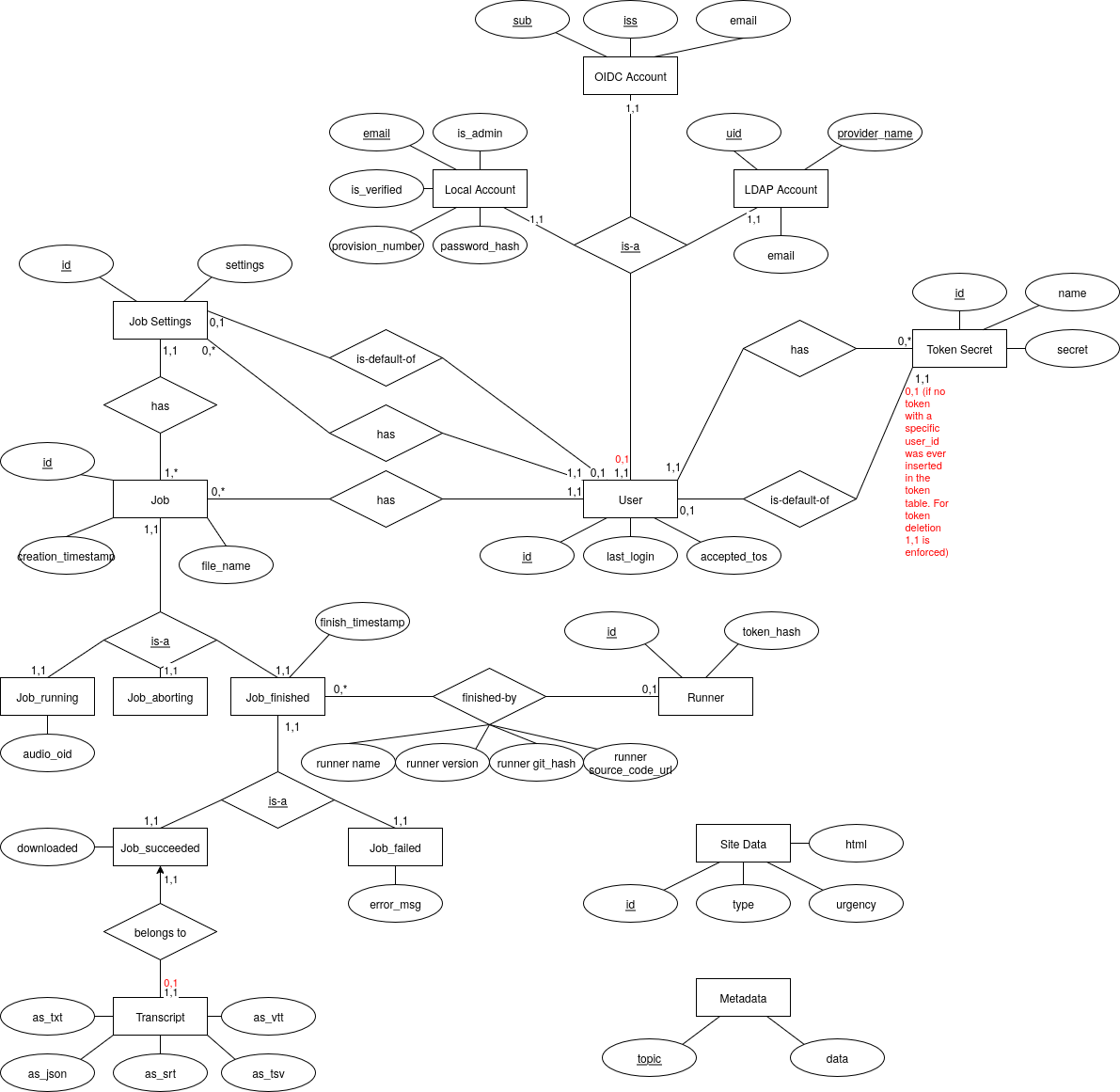
The red annotations are the attributes how they are actually currently enforced in the PostgreSQL schema in contrary to the ideal attribute (in black). Parts of this ER model is implemented a bit differently than one would expect:
Inheritance like it occurs in the job is implemented with table constraints instead of PostgreSQL inheritance feature. The reason for this is that FOREIGN KEY constraints don’t work well with PostgreSQL inheritance. See PostgreSQL wiki’s Don’t Do This for more information.
The is-default-of relations are not actually implemented as relations but as a is_default field in one of the tables with some added constraints. If I had implemented them as actual relations that would have introduced tables that reference each other which is always a pain to work with.
I have implemented two PostgreSQL functions and triggers: rotatesecret() and deleteaudio().
rotatesecret() creates a new default token secret if the default token secret of a user was deleted, effectively ensuring that there always exists a token secret for signing temporary JWT tokens.
deleteaudio() deletes PostgreSQL large objects containing the audio file once a Job gets deleted (which can also happen due to a CASCADE, e.g. when a user gets deleted). This is necessary because audio_oid is not explicitly referencing large objects (because it is not possible to reference system tables by default in PostgreSQL) which means that it wouldn’t CASCADE DELETE the large object otherwise.